

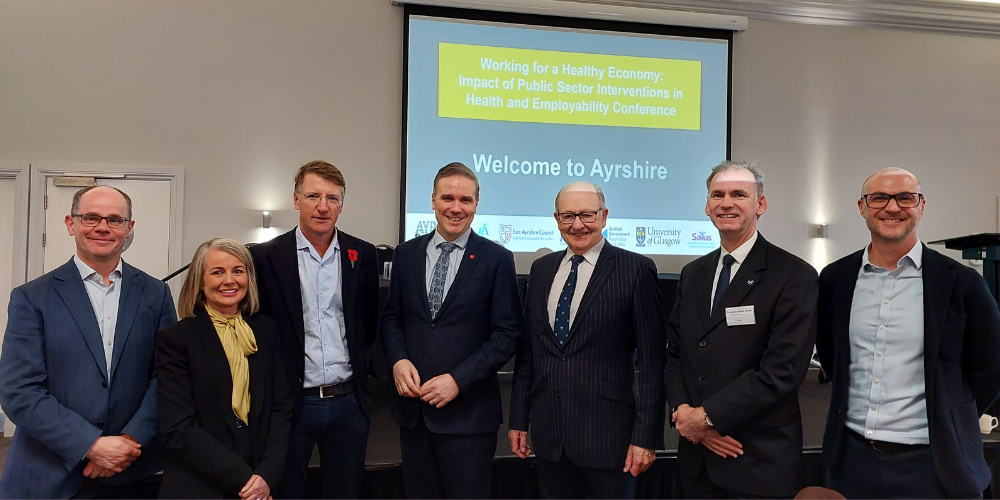
A national conference hosted in Saltcoats yesterday (Tuesday 3 November) heard how Ayrshire will spearhead national plans to tackle health-related economic inactivity.
Supporting unemployed working-age residents to rejoin the workforce, through health initiatives and employability programmes, is an approach that is improving life for people across Ayrshire.
Yesterday’s conference – titled Working for a Healthy Economy: Evidencing the Impact of Public Sector Interventions in Health and Employability – brought experts together from different national organisations to look at what is working well locally.
A series of workshops, presentations and discussions involving policymakers, researchers and employers was held in Saltcoats Town Hall with topics covered including:
- Ayrshire Growth Deal: Working for a Healthy Economy
- Young People, Health and Economic Inactivity
- Keep Britain Working with partners from the Department for Work and Pensions (DWP) and
- Collaboration for Health Equity in Scotland (CHES) – Good North Ayrshire.
The Council’s involvement in the Collaboration for Health Equity in Scotland (CHES) programme was put under the spotlight.
CHES – led by Public Health Scotland and Professor Sir Michael Marmot’s Institute for Health Equity – was launched in 2025 to strengthen and accelerate actions that will reduce health inequities for people living in North Ayrshire, Aberdeen City and South Lanarkshire.
Under the banner of Good North Ayrshire, three key workstreams – Good Start, Good Jobs and Good Health – are underway locally in three different neighbourhoods to help make life better for people by focusing on employment, ill-health prevention, early years, education and community-based support.
CHES work locally has been led by the North Ayrshire Integration Joint Board, which is the governing body of North Ayrshire Health and Social Care Partnership, and the Community Planning Partnership Board, which brings together public organisations including the Council, Third Sector groups and the NHS.
Tom Arthur, Minister for Business & Fair Work, welcomed everyone to the event and said: “I was pleased to open the Working for a Healthy Economy conference.
“Tackling economic inactivity and increasing labour market participation are key priorities for the Scottish Government as we work to grow the economy, reduce poverty and support sustainable public services.
“Good health and good work go hand in hand. Through our investment in the Working for a Healthy Economy programme as part of the Ayrshire Growth Deal, we are supporting approaches that help more people enter, remain and progress in work.
“By building on what works, we can create opportunity, support employers and help build a stronger and more prosperous Scotland.”
Topics discussed throughout the day included:
- how levels of work retention can be improved
- the existing measures that are in place to reduce health inequalities
- the success of Ayrshire’s existing integrated health and employability model through the delivery of the Ayrshire Growth Deal-funded Working for a Healthy Economy (WfHE) project and
- what local authorities, health boards and employability partnerships can do better in future.
North Ayrshire Council Leader Tony Gurney said: “The aim of the conference was to explore how local interventions can improve health outcomes for people who need support the most, and also to examine how we can help residents get access to quality jobs that are sustainable.
“There was a lot to talk about and some very positive takeaways about the good work already being done here in North Ayrshire. As ever, our aim is to build on these positives and strive to further improve life for everyone.”
The conference builds on the success of the WfHE programme, which has been delivered by the NHS Salus Return to Work Services.
By offering rapid access to professional health support, WfHE supports Ayrshire residents whose health conditions impact their ability to move into, remain in, or progress in work.
This health service is aligned with and embedded within employability services across the region and offers integrated health and employability support to manage health conditions and improve employment outcomes for people.
Early findings from an independent evaluation of WfHE, by the University of Glasgow’s Healthy Working Lives group, have been positive. These include evidence of positive health and employability outcomes for people across Ayrshire and demonstrate the positive early impact from Ayrshire Growth Deal investment.
The university team also believes the emerging evidence provides a unique opportunity to position Ayrshire as a national learning site for tackling health-related economic inactivity.
Since its launch in 2021, the programme has supported residents whose health conditions affect their ability to move into, remain in or progress in work through rapid access to professional health support.
Yesterday’s keynote speakers included Sir Charlie Mayfield, Lead Non-Executive Board Member for HM Treasury; Professor Ewan Macdonald CBE, founder of the Healthy Working Lives Group (HWLG) at the University of Glasgow and Paul Johnston, Chief Executive of Public Health Scotland.
Importantly, several North Ayrshire residents shared powerful personal stories at the conference, highlighting the transformative impact of support from Working for a Healthy Economy (WFHE) and Working North Ayrshire – which is the Council’s employability service.
They described the support as a lifeline, helping to improve mental health, support recovery and restore confidence that employment can be part of a healthier, more positive future. Councillor Gurney added: “I would like to thank everyone who contributed to yesterday’s event, particularly the residents who shared their stories.”